
Ingela Palmertz
FIGURES IN ROOM
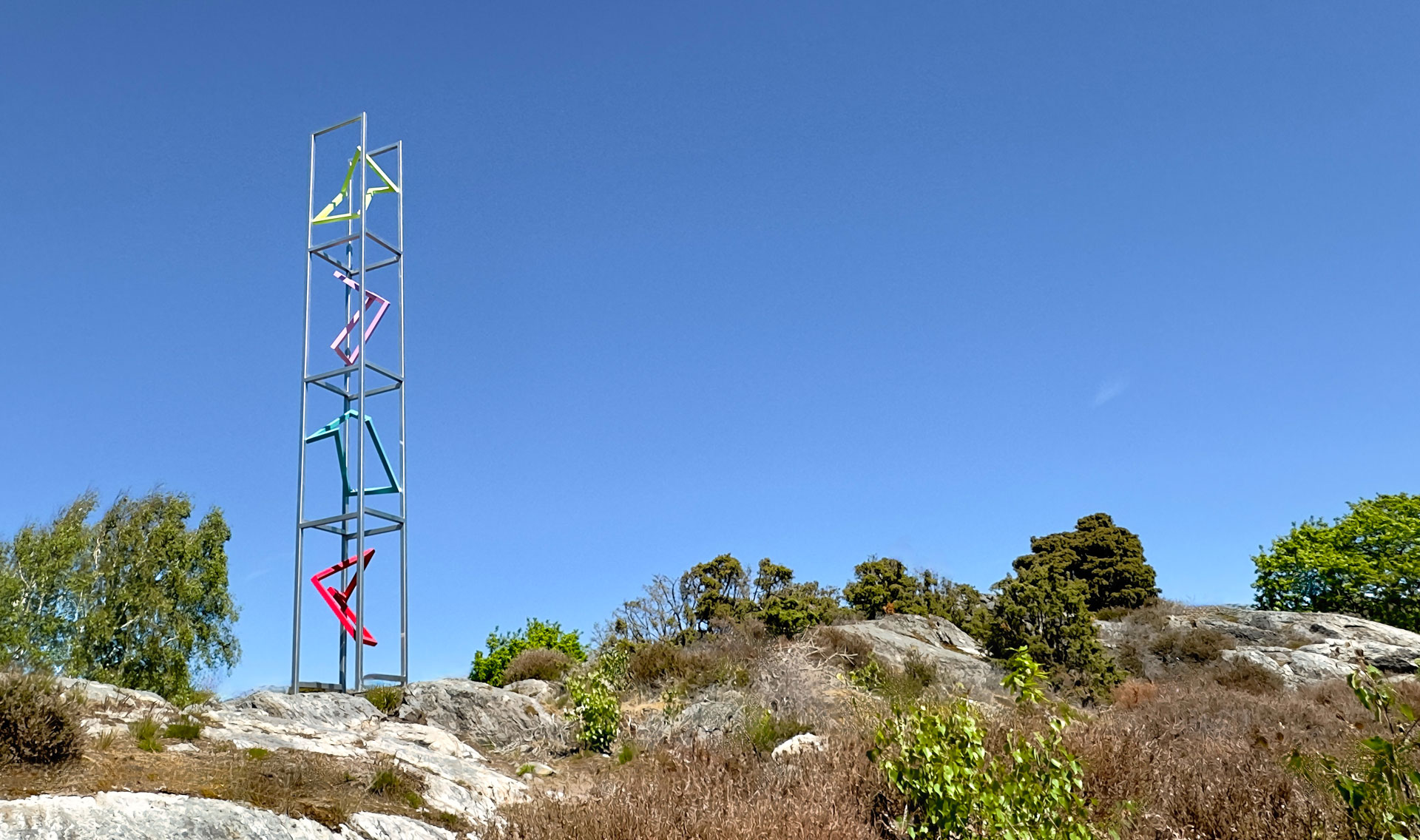
An airy tower stands tall on a cliff at Pilane. In four similar-sized modules, four smaller elements seem to hover freely, framed by a silvery main structure. The abstract shapes are seemingly simple. Our eyes, which are accustomed to looking for something recognisable, eventually spot the stylised figures. A slumped body on a chair. A back with splayed legs … A visual echo of an inverted reality, shaped with the industrial precision of minimalism and a concretist striving for autonomous form and pure colour.
The artist Ingela Palmertz first took a PhD in organic chemistry, before switching to an artist career in the 1980s. Her background in natural sciences is noticeable in her precise, terse and elegant design, where nothing is superfluous. Her visual expression is akin to constructivism. One of the fundamental principles of this movement, which dates back to the early 1920s, is that art should be non-figurative and based on geometric shapes and bright colours.
The basic shapes Palmertz elaborates on originate in model studies that she gradually reduced to their essentials. The spatial, open structures are neither depictive nor narrative. Their purpose is to relate to one another and to the surroundings, as if challenging gravity. There are no solid walls here, only a reliable structure — enigmatic, poetic and visually confident.
Ingela Palmertz, born in 1941, is a sculptor, painter and printmaker. She studied at the Valand Academy and the Hovedskou school of painting. Palmertz has designed many public works and is represented in the collections of Gothenburg Art Museum, the Museum of Sketches in Lund, the Public Art Agency and several municipalities and county administrative boards.